
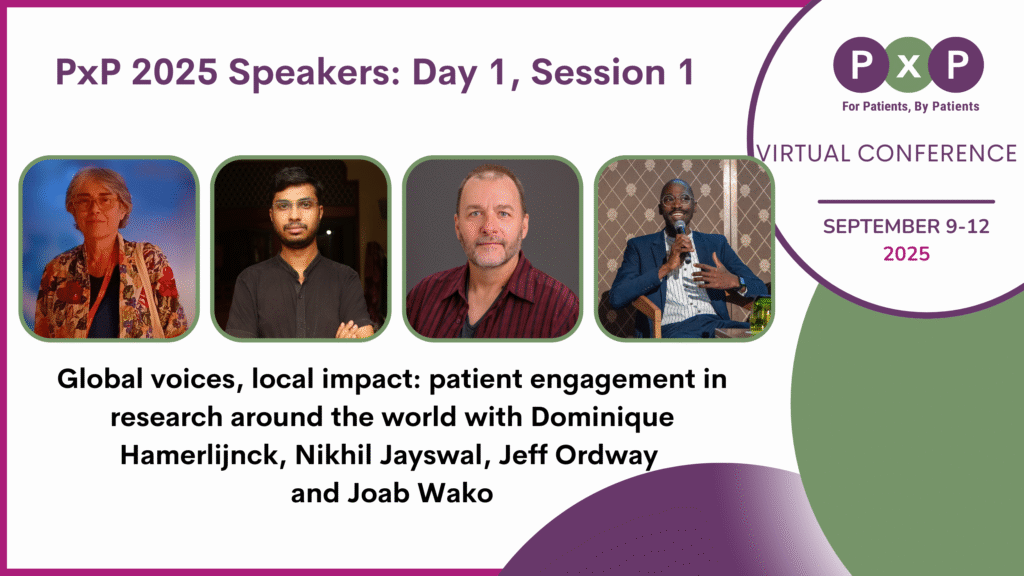
The opening session at the PxP 2025 conference was about the state of patient engagement in research in different parts of the world, where speakers see things going, and what they see as unique challenges and opportunities from their own perspectives.
Speakers: Dominique Hamerlijnck, Nikhil Jayswal, Jeff Ordway and Joab Wako (facilitator)
Recording is available here: https://youtu.be/xJwAKSoHGNs
We were very grateful to the attendees for their excellent engagement with the session. This page is a summary of some of the conversations from the live session and re-watch party. This summary also includes resources and anonymised quotes that were shared by attendees in the Zoom Chat. We have collated everything here as part of our commitment to accessibility, so that people who attended the session have the opportunity to reflect on the content in a different format, and also so that people who were unable to join the session live can still have the opportunity to learn with and from their peers.
Please note that some of the quotes shared below have been attributed to one of the session speakers, as these are words that attendees shared in the Chat which particularly resonated with them.
This summary article was created with assistance from Microsoft Copilot, an AI-powered tool that helped organize, synthesize, and format content based on session notes and discussions. All notes were reviewed and anonymized by the PxP team before Copilot assisted with the task.
1. Cross-Cultural Learning and Role Models
Participants emphasized the importance of learning from other communities and disease areas with long-standing advocacy traditions, such as HIV activism, to inspire and guide emerging patient engagement efforts.
“The HIV world has been involved in research for over 30 years... borrow from those who have been doing it for a long time.”
“I recently read about how it began [patient advocacy in other communities] and shared with our community as well, to motivate patients to engage more in advocacy.”
2. The Burden of Proving Legitimacy
A recurring theme was the emotional and psychological toll of constantly needing to justify the presence of patient partners in research spaces. This dynamic creates a power imbalance and undermines genuine collaboration.
“That need to constantly re-prove that patients ‘deserve’ a seat at the table feels like starting at square one again.”
“Power plays... with PxP, champion advocates, and their allies, surely the day is coming when you will have to justify why you don’t have patient partners rather than trying to justify why you do.”
3. The Duality of Roles: Patients and Professionals
Attendees discussed the complex interplay between being both a patient and a professional (e.g., researcher, clinician, advocate). This dual identity can offer unique insights but also introduces challenges in navigating vulnerability and credibility.
“Medical professionals also believe they understand as ‘they are patients too’ but having medical expertise changes their patient experience – the vulnerability difference is significant.”
“Many researchers are ‘heads down’ in the laboratory... a lunchtime talk about living with a neurological condition opened their eyes to the real-world impact of their work.”
4. Challenging the ‘Good Patient’ Narrative
The session highlighted how societal and systemic expectations often pressure patients to conform to a “good patient” persona—compliant, agreeable, and non-disruptive. This can silence authentic voices and perpetuate inequities.
“I’ve felt like their project a lot... if I chose to be a normal, non doctor-pleasing patient, they will abandon me.”
“Just because you might not ‘like’ what a patient/advocate has to say, doesn’t mean they shouldn’t be at the table.”
5. Asking Bold Questions and Shifting Paradigms
Patient partners were celebrated for their ability to ask uncomfortable but necessary questions—ones that others may not think to ask or feel empowered to raise.
“As a patient, we have the ability to not only ask those questions but quite often we are not hindered by academic pressures to stay in ‘our lane’.”
“Hopefully they are willing to entertain discussion around those questions… sometimes they get put in a ‘parking lot’… that magically disappears.”
6. Compensation and Sustainability
The conversation around fair compensation was robust, with recognition of global disparities and the need to value lived experience as expertise.
“Passion without pay quickly turns into burnout.”
“In India, nonprofit work is often expected to be free, almost divine, as if passion alone pays the bills.”
“We bring lived expertise – which is of great value. Compensation matters for you and the future yous.”
7. Stigma and Cultural Barriers
Stigma around illness remains a significant barrier to patient engagement, particularly in regions where health conditions are taboo or misunderstood.
“I advocate for those who can’t advocate for themselves. I have been sharing my cancer journey to break silence and stigma around cancer in my community.”
8. Institutional Mandates vs. Authentic Inclusion
While some systems require patient involvement, the depth and authenticity of that engagement varies widely.
“In Leeds, all researchers and students must present their proposals to the PPIE [patient and public involvement and engagement] group before research goes ahead.”
“In Canada... it is still up to the researchers and clinicians how ‘real’ the inclusion of patients is.”
9. Capacity Building and Avoiding Burnout
Attendees discussed the need to grow the patient partner community and support sustainable involvement, including mentorship and peer networks.
“Beyond saying yes to everything, what can we do as patient partners to say ‘great opportunity, and can I introduce you to someone else’?”
“I try to have patient partner meetups... but it is still the experienced people turning up, not those we need to encourage into the role.”
Reflections from the Rewatch Parties
The PxP steering committee hosted rewatch parties to ensure broader access to the session. Many attendees expressed gratitude for this inclusive approach.
“Having them available is greatly appreciated! I would have missed it all otherwise.”
“So great to have you all joining us on the Rewatch parties.”
Resources shared in the Chat
- PxP 2025 Steering Committee Biographies https://pxphub.org/event/steering-committee-2025/
- How-To Guide for Patient Engagement in Research from CIHR Institute of Musculoskeletal Health and Arthritis https://cihr-irsc.gc.ca/e/27297.html#a2
- PxP Speaker Biographies https://pxphub.org/event/speakers-2025/
- Frontier Science UK Clinical Trials https://frontierscience.co.uk
- Crohn’s and Colitis Canada https://crohnsandcolitis.ca/
- Greater Plains Collaborative Clinical Research Network https://gpcnetwork.org
- Patient-Centered Outcomes Research Clinical Research Network (USA) https://pcornet.org
- National Academy of Medicine (USA) https://nam.edu/our-work/programs/leadership-consortium/assessing-meaningful-community-engagement/
- Patient Centered Outcomes Research Institute Engagement Resources https://www.pcori.org/engagement-research/engagement-resources
- Patient Engagement Toolkit from Kaiser Permanente Center for Health Research https://research.kpchr.org/Patient-Engagement-Toolkit
- European Patients’ Academy on Therapeutic Innovation (EUPATI) https://eupati.eu/
- Parkinson’s UK page on patient and public involvement (PPI) https://www.parkinsons.org.uk/research/patient-and-public-involvement-research
- Summary about The Speed of Trust Book https://www.iidmglobal.com/elearning/business-book-summary/id132043-the-speed-of-trust.html
- Savvy Cooperative Blog that critiques the phrase ‘We are all patients’ https://www.savvy.coop/blog/we-are-all-patients-is-the-all-lives-matter-of-patient-advocacy
- Integrating the lived experience conditions and care in the ECHO model https://pmc.ncbi.nlm.nih.gov/articles/PMC7302038/#:~:text=The%20Show%20Me%20ECHO%20'lived,%2C%20go%20to%20showmeecho.org.
- IBD India web page https://ibdindia.co.in
 English (UK)
  Français