
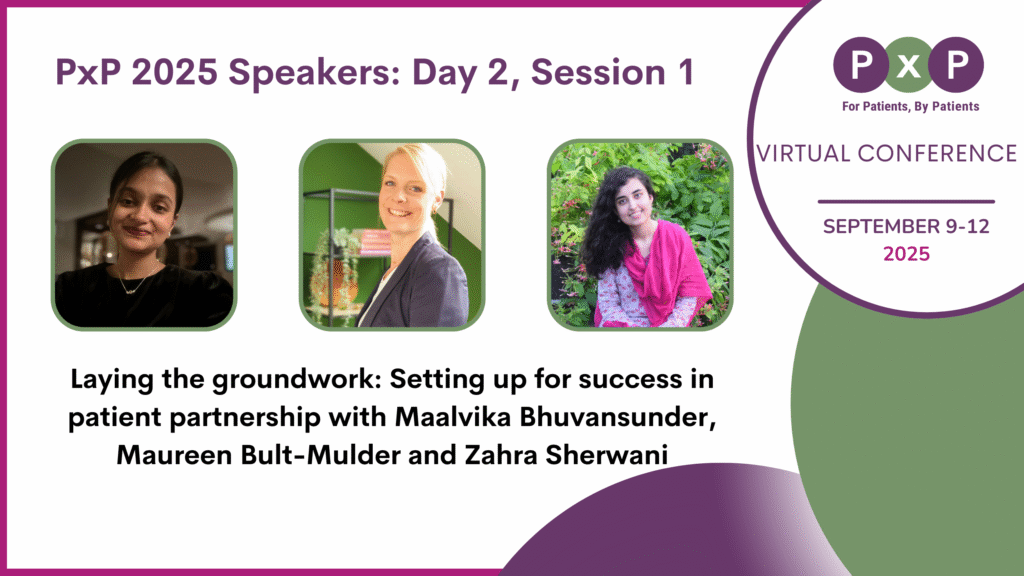
This summary captures key themes, reflections, and resources shared during the PxP 2025 session "Laying the Groundwork: setting up for success in patient partnership”. Speakers shared how they have set themselves up for success on a research team that includes patient partners, not matter their experiences or the role they play. The session focused on good aspects of co-design in hopes of ensuring patient partners are equipped to fulfill their roles. It included people who brought perspectives of patient partners, researchers, and a person who facilitates patient engagement in research.
Facilitator: Maalvika Bhuvansunder
Speakers: Zahra Sherwani, Maureen Bult-Mulder
Recording is available here: https://www.youtube.com/watch?v=EnJ6y6c0gHI&t
We were very grateful to the attendees for their excellent engagement with the session. This page is a summary of some of the conversations from the live session and re-watch party. This summary also includes resources and anonymised quotes that were shared by attendees in the Zoom Chat. We have collated everything here as part of our commitment to accessibility, so that people who attended the session have the opportunity to reflect on the content in a different format, and also so that people who were unable to join the session live can still have the opportunity to learn with and from their peers.
Please note that some of the quotes shared below have been attributed to one of the session speakers, as these are words that attendees shared in the Chat which particularly resonated with them.
This summary article was created with assistance from Microsoft Copilot, an AI-powered tool that helped organize, synthesize, and format content based on session notes and discussions. All notes were reviewed and anonymized by the PxP team before Copilot assisted with the task.
1. Compensation and Equity
Compensation for patient partners was a major topic, with attendees discussing funding limitations, ethical considerations, and the need for transparent policies. Participants shared experiences from different countries and institutions, highlighting disparities and advocating for fair recognition of contributions.
"Being a co-investigator or co-author are ways to compensate."
"Some patients on disability are limited to income they can receive."
"If others are being compensated, all should be compensated."
"Offering compensation should be the norm — it enables broader participation."
2. Authorship and Power Dynamics
The discussion explored how patient partners are credited in academic publishing and the need to shift power dynamics in research. Attendees emphasized the importance of meaningful inclusion from the beginning of projects and questioned traditional hierarchies.
"Perhaps patient partners should be the ones directing the research program and using researchers as servants to navigate through the research process."
“Speaking of how to credit patient partners, the academic publishing realm still seems antiquated and medieval as a knowledge mobilization tool.”
3. Emotional Labor and Support
Participants reflected on the emotional toll of engagement, especially for those dealing with trauma or chronic conditions. The importance of support, flexibility, and shared responsibility was emphasized.
"It is a lot to put on patients — but with time and support, it can be validating."
"We have to FEEL that it is ok to pull back, not just hear the words."
"There should be multiple patient partners involved so no one bears the full responsibility."
4. Learning and Dual Roles
The session highlighted the evolving roles of patient partners, many of whom are also researchers or advocates. Attendees discussed the importance of continuous learning and the value of understanding broader issues beyond personal experience.
"I want to understand what others are facing too, not just my own issues."
"Those shared skills between being a patient and a researcher are interesting."
Resources shared in the Chat
PxP 2025 Steering Committee: https://pxphub.org/event/steering-committee-2025/
- PRPNetTT (a think tank connecting experienced patient research partners across the UK in rheumatology) Reflections: https://prpnettt.substack.com
- Patient-Centered Outcome Research Institute (PCORI) Engagement Tools: https://www.pcori.org/engagement/engagement-resources/Engagement-Tool-Resource-Repository
- Involvement Matrix: https://www.kcrutrecht.nl/involvement-matrix/
- CANTRAIN Clinical Trial Training: https://wecantrain.ca/home/clinical-trial-training-programs/patients-and-community-partners/
- Family Engagement Research Course: https://ferprogram.ca/
- European Patients’ Academy on Therapeutic Innovation (EUPATI): https://eupati.eu/
- WHO Meaningful Engagement Framework: https://www.who.int/publications/i/item/9789240073074
- PxP Fact vs Fiction: https://pxphub.org/fact-vs-fiction-helping-you-sift-through-online-information/
- How to Read a Scientific Paper: https://pxphub.org/wp-content/uploads/2025/05/French-How-to-Read-a-Scientific-Paper.pdf
- Patient Authorship Resources:
- article called “Guidance on authorship with and acknowledgement of patient partners in patient-oriented research” - https://researchinvolvement.biomedcentral.com/articles/10.1186/s40900-020-00213-6
- article called “Patient partner engagement in the publication process: challenges and possible solutions” - https://bmcmedresmethodol.biomedcentral.com/articles/10.1186/s12874-025-02495-4
- article called “Seven Actions Towards Advancing Patient Authorship and Collaboration in Peer-Reviewed Publications” - https://pubmed.ncbi.nlm.nih.gov/40603810/
- article called “Patient authorship of medical research publications: An evolution, revolution, and solution?” - https://onlinelibrary.wiley.com/doi/full/10.1002/leap.1607
- article called “Hidden in plain sight? Identifying patient-authored publications” - https://researchinvolvement.biomedcentral.com/articles/10.1186/s40900-022-00346-w
 English (UK)
  Français