
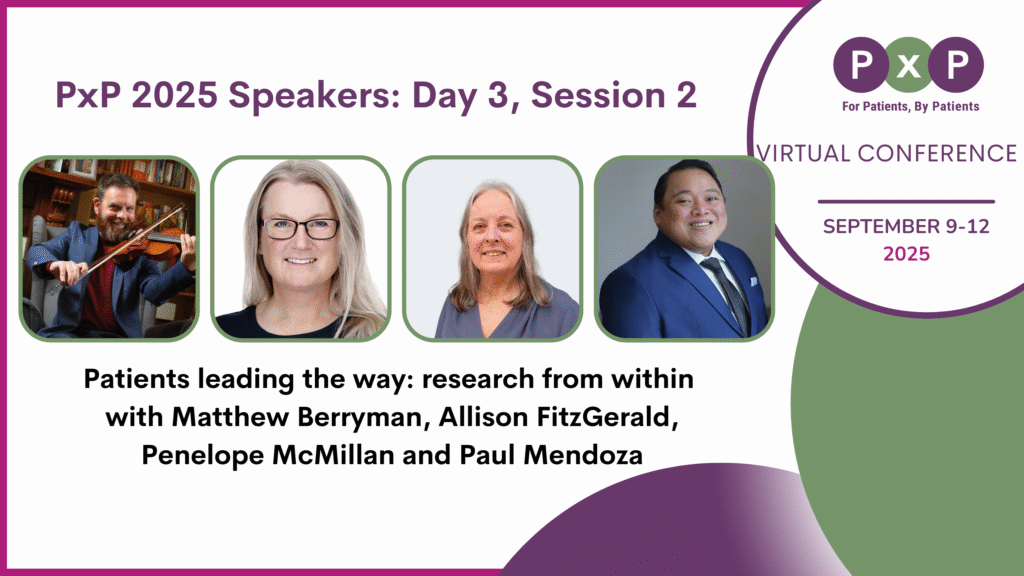
At the Patients leading the way: research from within session, presenters shared examples of how patients are changing the research system from within by leading research based on their community's priorities. They shared some of the challenges they've overcome doing research in this way such as funding, ethics approval, and other considerations. Speakers also shared and discussed how they have invited clinical and scientific experts on to their teams and flipped the script on typical research teams.
Facilitators: Allison FitzGerald and Paul Mendoza
Speakers: Matthew Berryman, Penelope McMillan
Recording is available here: https://www.youtube.com/watch?v=Wf5vJ9sdDnM
We were very grateful to the attendees for their excellent engagement with the session. This page is a summary of some of the conversations from the live session. This summary also includes resources and anonymised quotes that were shared by attendees in the Zoom Chat and Q&A tab. We have collated everything here as part of our commitment to accessibility, so that people who attended the session have the opportunity to reflect on the content in a different format, and also so that people who were unable to join the session live can still have the opportunity to learn with and from their peers.
Please note that some of the quotes shared below have been attributed to one of the session speakers, as these are words that attendees shared in the Chat which particularly resonated with them.
This summary article was created with assistance from Microsoft Copilot, an AI-powered tool that helped organize, synthesize, and format content based on session notes and discussions. All notes were reviewed and anonymized by the PxP team before Copilot assisted with the task.
1. Whole-Person Engagement and Inclusion
Participants emphasized the importance of engaging patient partners as whole individuals, not just through the lens of their condition.
"Engaged as a whole person."
"That is a very important factor, considering patient partners as a whole person, and not just their condition."
2. Advocacy, Remuneration, and Representation
Speakers shared how advocacy work and equitable remuneration are essential for meaningful patient engagement.
"Loved Matthew, PhD’s comment about finding meaning through doing social good after a catastrophic health event. And yeah, I love that he is an advocate for equitable remuneration of patient partners/ lived experience experts."
3. Power Dynamics and Co-Design
The session explored how patient-led research challenges traditional power structures and promotes co-design.
"Yes [name]....there is such a gap, and often goodwill and good relationships and we still struggle with the research and researchers because power is so hard to unpack, especially institutional power in its command of research process and outputs."
"So glad to learn of this, and it inspires me to keep trying to unpack the power differences in research teams."
4. Capacity Building and Collaboration
Participants discussed strategies for building capacity among patient partners and sustaining global collaborations.
"Especially as it takes time, and it can be hard to learn the technical skills."
"Collaboration = more powerful voice."
5. Storytelling and Impact
Storytelling was highlighted as a powerful tool to drive research and policy change, especially for misunderstood or invisible conditions.
"Where do you see the role of storytelling in pushing the envelope on conditions that are misunderstood & or invisible to effect research to be done & policy changes to be made where we struggle to balance be stigma adverse but wanting broadcast the need for people to care & help change things."
6. Declaration of Helsinki and Systemic Change
The updated Declaration of Helsinki was discussed as a lever for systemic change and greater patient involvement.
"Meaningful engagement with potential and enrolled participants and their communities should occur before, during, and following medical research. Researchers should enable potential and enrolled participants and their communities to share their priorities and values; to participate in research design, implementation, and other relevant activities; and to engage in understanding and disseminating results."
Other Reflections
Attendees shared heartfelt reflections on the emotional and practical aspects of patient-led research. The importance of being heard, the challenges of slow research timelines, and the value of inclusive collaboration were recurring themes.
"The despair of feeling unheard was at times more debilitating than the heavy pain itself which I was experiencing daily."
"I always say, once you've drunk the Kool-aid, you can't go back."
Resources shared in the Chat
Speaker bios: https://pxphub.org/event/speakers-2025/
Mental health helplines: https://www.helpguide.org/find-help
Stroke co-design resources: https://stroke-trials-cre.org.au/resources/co-design-collaboration-resources/
Clinical trials involvement toolkit from Australia: https://involvementtoolkit.clinicaltrialsalliance.org.au/toolkit/
 English (UK)
  Français