
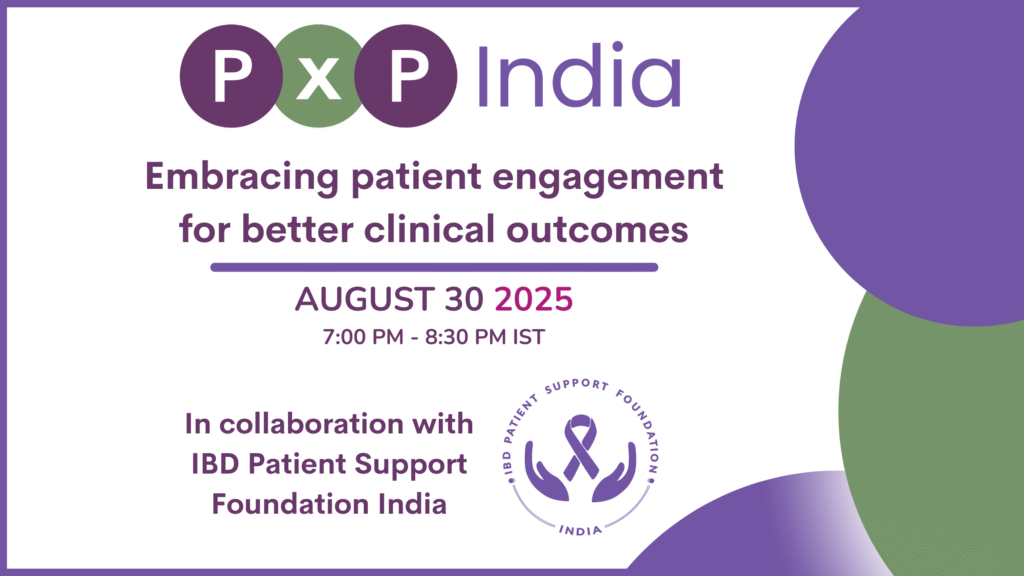
For the first time in India, PxP brought together a panel of experts to discuss the value of patient engagement in clinical research and at point of care. Featuring pioneering experts who are daring to challenge the status quo in a highly traditionalist healthcare system, this virtual session used storytelling, provocative debate, and Q&A to showcase how patients can convert their lived experience into valuable expertise to help shape research and healthcare processes.
This session was designed for clinical researchers, medical practitioners, patient advocates, and patients eager to see the power dynamic shifting and patients taking their rightful place as collaborators in the healthcare ecosystem.
Speakers: Maalvika Bhuvansunder, Nikhil Jayswal, Clarinda Cerejo, Vachasamrita S., Shruti Gupta, Naumika Khanna, Dr. Pooja Sharma, Dr. Suman Karanth
Recording is available here: https://www.youtube.com/watch?v=Gp54eV-nTSA&list=PLLgB6pZVyUdi8ydpidb-wckzLJvOZvnDD&index=2
We were very grateful to the attendees for their excellent engagement with the session. This page is a summary of some of the conversations from the live session. This summary also includes resources and anonymised quotes that were shared by attendees in the Zoom Chat. We have collated everything here as part of our commitment to accessibility, so that people who attended the session have the opportunity to reflect on the content in a different format, and also so that people who were unable to join the session live can still have the opportunity to learn with and from their peers.
Please note that some of the quotes shared below have been attributed to one of the session speakers, as these are words that attendees shared in the Chat which particularly resonated with them.
This summary article was created with assistance from Microsoft Copilot, an AI-powered tool that helped organize, synthesize, and format content based on session notes and discussions. All notes were reviewed and anonymized by the PxP team before Copilot assisted with the task.
1. Patient-Centric Research and the PACER Project
The PACER Project (Patients Advocating for Clinical Research) was a central focus of the session. It aims to empower patients to become informed contributors to clinical research, shifting the narrative from passive participation to active leadership. Inspired by consumer rights movements like “Jaago Graahak Jaago,” PACER is building a coalition of over 30 patient advocacy groups to shape research priorities, improve transparency, and promote ethical engagement.
“Participation in research – Responsibility for a Healthy India.”
“PACER is doing for research what ‘Jaago Graahak Jaago’ did for consumers.”
2. Lived Experience as Expertise
Participants shared powerful personal stories of living with chronic and rare conditions, underscoring the emotional and physical toll of navigating the healthcare system. These narratives emphasized that lived experience is not supplementary—it is central to ethical and impactful research. The session highlighted how personal journeys can inform policy, improve care, and inspire others.
“I was diagnosed with Type 1 Diabetes at 7, hypothyroidism at 8, and epilepsy at 15. At 23, I survived a failed neurosurgery that left me with eleven burns in my brain.”
“Surgery as a juvenile is like having zero say on your own body.”
3. Caregiver Roles and Recognition
Caregivers were acknowledged as essential yet often invisible contributors to the patient journey. The discussion explored both the emotional labor of caregiving and the tension that can arise when caregivers’ voices overshadow those of patients. There was a call to better support caregivers while ensuring patient autonomy remains central.
“Caregivers are the invisible strength of the healthcare journey, holding our hands in silence while carrying our pain as their own.”
“Caregivers are also usurpers of our needs and opinions.”
4. Peer Support and Community Education
The importance of peer-led education and support networks was emphasized as a way to bridge gaps in understanding and access. Participants advocated for practical, community-based education models that empower patients to support one another and navigate complex conditions more effectively. Peer support was seen as a tool for resilience and empowerment.
“Some patients don't know the destructive networks in diabetes complications—we must educate through peer support.”
“100% agree with the value and importance of peer support.”
5. Equity and Inclusion in Global Health Research
Several participants raised concerns about the exclusion of the Global South from international research leadership. Despite having strong medical expertise, researchers and advocates from these regions often face systemic barriers to participation and recognition. The session called for more inclusive frameworks that value diverse voices and contexts.
“The Global South is suffering with not being included… we are kept behind.”
“This narrative still exists, Dr. Pooja.”
6. Youth Leadership and Intersectional Advocacy
Young advocates shared their journeys of navigating multiple chronic conditions while leading change in their communities. Their work spans grassroots organizing, policy engagement, and global representation, demonstrating the power of youth voices in shaping inclusive health systems. Intersectionality—across age, gender, geography, and condition—was a recurring theme.
“Seeing all of you join hands for this mission strengthens my belief that change is possible.”
“From speaking on global platforms to working at the grassroots level… ‘nothing about us, without us’ is the need of the hour.”
7. Communication, Language, and Trust
Language was identified as a powerful tool that can either build trust or reinforce barriers. Participants discussed how medical jargon, cultural disconnects, and assumptions can alienate patients. There was a call for clearer, more empathetic communication between providers and patients, and for building trust through transparency and respect.
“The language between doctor and patient is so important.”
“Knowledge is only a curse to people who want to mislead others.”
8. Patient-Led Research and Publishing
The session explored how patients are increasingly contributing to research design, data collection, and dissemination. There was enthusiasm for alternative publishing formats, such as videos and podcasts, that make research more accessible and inclusive. Patient-led studies were celebrated as a model for ethical and impactful research.
“There will be a session on Day 3 of PxP about ways patient partners are sharing research—beyond papers.”
“Our latest patient-led research publication at Cankids: Malnutrition among Pediatric Cancer Patients.”
Resources shared in the Chat
- PACER Project: https://www.cankidsindia.org/pacer.html
- Speaker bios: https://pxphub.org/event/pxp-india-2025/
- Clarinda Cerejo’s paper titled: “The untold emotional toll of navigating the health system: the journey of patients in/from India, living with serious and/or chronic conditions” - https://www.tandfonline.com/doi/full/10.1080/03007995.2024.2383732
- Canadian Institute of Health Research’s Institute of Musculoskeletal Health and Arthritis How-To Guide for Patient Engagement in Research: https://cihr-irsc.gc.ca/e/27297.html#a2
- European Patients’ Academy on Therapeutic Innovation (EUPATI): https://eupati.eu
- Cochrane Collaboration homepage: https://cccrg.cochrane.org
- Clarinda Cerejo’s podcast: https://notjustpatients.com
- Lama2 India: https://lama2india.com
- Patient-led research publication: https://www.researchgate.net/publication/394537101_Malnutrition_among_Pediatric_Cancer_Patients_A_Study_of_Government_Hospitals_in_Delhi
- Reporting drug side effects (video): https://youtu.be/MErVEfuP4Ro?si=P6vwbAlV5qacb2Vj
- Navigating clinical trials in India (video): https://youtu.be/NFqIMNdiX9E?si=62voaMMHFDBXH2rr
- Publishing process with patient partners as co-authors (video): https://www.youtube.com/watch?v=v4M7KccdCrs
- Patient editor’s take on publishing (video) featuring Richard Stephens: https://youtu.be/2gpi5ztGONQ?si=SpQUeOgYtKuYDCj7
 English (UK)
  Français