
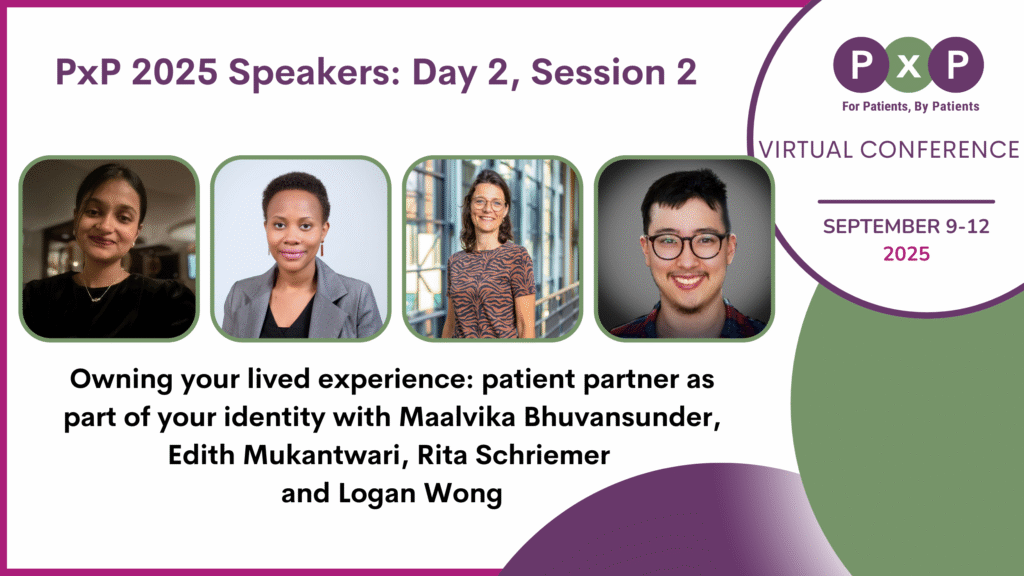
The Owning your lived experience: patient partner as part of your identity session explored owning your lived experience as one part of your identity. The session examined the duality of being both a patient and using that experience and knowledge in your professional role. Panelists discussed the ethical, moral, and identity challenges, and the potential implications of being transparent about their patient part of their identity in a professional role.
Facilitator: Edith Mukantwari
Speakers: Maalvika Bhuvansunder, Rita Schriemer, Logan Wong
Recording is available here: https://www.youtube.com/watch?v=F39Ulqbe01A&t
We were very grateful to the attendees for their excellent engagement with the session. This page is a summary of some of the conversations from the live session and re-watch party. This summary also includes resources and anonymised quotes that were shared by attendees in the Zoom Chat. We have collated everything here as part of our commitment to accessibility, so that people who attended the session have the opportunity to reflect on the content in a different format, and also so that people who were unable to join the session live can still have the opportunity to learn with and from their peers.
Please note that some of the quotes shared below have been attributed to one of the session speakers, as these are words that attendees shared in the Chat which particularly resonated with them.
This summary article was created with assistance from Microsoft Copilot, an AI-powered tool that helped organize, synthesize, and format content based on session notes and discussions. All notes were reviewed and anonymized by the PxP team before Copilot assisted with the task.
1. Reclaiming the Role of “Patient”
Participants challenged the notion of being “just a patient,” emphasizing that lived experience is a form of expertise deserving equal respect on research teams.
“We don’t expect other ‘professionals’ to be ‘more than an academic’ on our research teams. The way I see it, until we, as patient partners, fully embrace the importance of our own expertise, I don’t think that others on research teams will.”
“Sometimes we choose to wear the Patient hat as it distinguishes us at the table — we aren’t the doctor, we aren’t the academic, we are wearing the hat/role of Patient and that is our focus and viewpoint.”
“There are so many skills that can be acquired from being a patient/patient partner and a high healthcare user including communications, problem solving and project management — so sometimes I choose to emphasize those aspects vs personal medical details.”
2. Disclosure: A Personal and Strategic Choice
Disclosure of health conditions was described as deeply personal, often influenced by stigma, safety, and context.
“I agree with my colleagues that choosing when to disclose one’s ‘patient status’ is a complex personal choice. There’s a lot of vulnerability involved in disclosing.”
“I tend to hide my mental health ailments even more than my physical.”
“I have to justify my physical ailments as well when I exit my car in a disabled parking spot because you can't see emphysema or osteoarthritis.”
3. Stigma and Identity in Research Spaces
Stigma — both societal and internalized — emerged as a major barrier to engagement. Mental health stigma was particularly prominent.
“Mental health STIGMA is strong in global health/medical research/policymaking spaces. Even among us as patient partners.”
“Science without compassion is just as dangerous as ignorance.”
The conversation also touched on how professional identities can be overshadowed by advocacy roles, leading to feelings of being boxed in or misunderstood.
“Though I don't advocate much on the personal health issues I have (rather I advocate for the patient voice), it has been interesting to me how quickly my professional circles have repositioned who I am, and seemingly forgotten my professional expertise by being an advocate for patient voice.”
4. Caregiver Perspectives and the Need for Distinction
Caregivers were recognized as vital partners, with participants emphasizing the importance of distinguishing caregiver experience from patient experience — especially in pediatric research.
“I think it’s really important to partner with both caregivers and patients but we have to recognize that the caregiver brings the caregiver experience and that can’t be substituted for that of a patient. In a lot of paediatric research, traditional patient partners have been caregivers but more and more the shift is including more youth and patients. This shift is so important.”
5. Trust and Relationship Building
Trust was identified as foundational to meaningful engagement. Disclosure and partnership were seen as evolving processes.
“Patient partners SHOULD be selecting the research and researcher they work with, as much as the other way around.”
Other Reflections
The session sparked deep emotional responses and highlighted the need for safe spaces — both physical and relational — for patient partners to share and grow.
“My takeaway is how complicated it is disclosing your background, and deciding when it is safe to do so, and there can be implications either way. My hats off to everyone that is as open as these speakers have been with sharing their lived experiences.”
“They are courageous and bold.”
“Having a peer community as a consumer in research is so important. It’s a game changer.”
The “Quiet Room” offered during the session was appreciated as a space for mental health and mindfulness support.
Resources shared in the Chat
Rosalynn Carter Institute for Caregivers: https://rosalynncarter.org
 English (UK)
  Français