
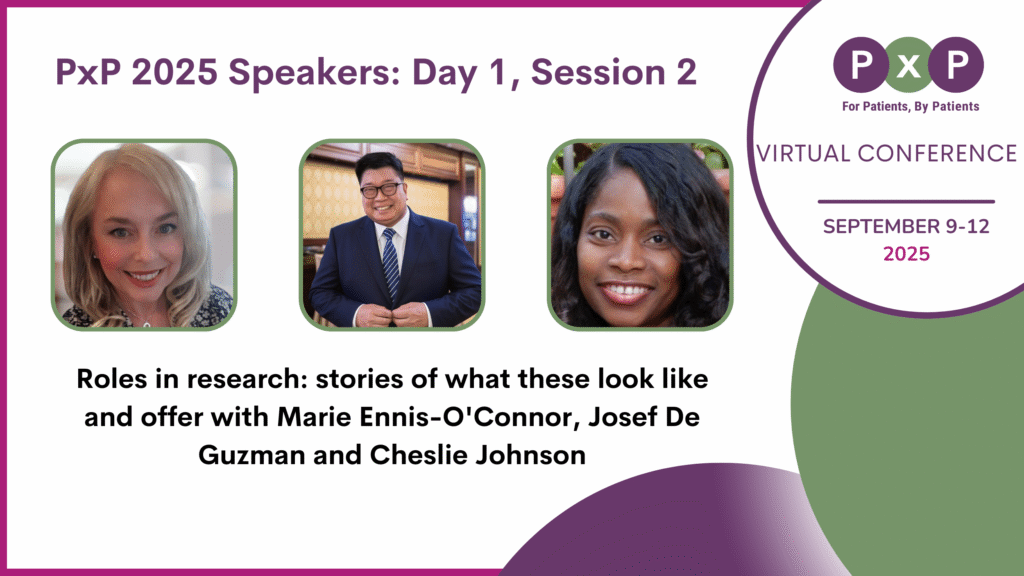
This summary captures key themes, reflections, and resources shared during the PxP 2025 session "Roles in research: stories of what these look like and offer”. Speakers shared their experiences as patient partners in various roles, including what their contributions look like in different projects and initiatives. They discussed the supports they have needed and how their involvement has changed over time.
Speakers: Josef De Guzman, Cheslie Johnson and Marie Ennis-O'Connor (facilitator)
Recording is available here: https://www.youtube.com/watch?v=MWXZXCyaDAQ
We were very grateful to the attendees for their excellent engagement with the session. This page is a summary of some of the conversations from the live session and re-watch party. This summary also includes resources and anonymised quotes that were shared by attendees in the Zoom Chat. We have collated everything here as part of our commitment to accessibility, so that people who attended the session have the opportunity to reflect on the content in a different format, and also so that people who were unable to join the session live can still have the opportunity to learn with and from their peers.
Please note that some of the quotes shared below have been attributed to one of the session speakers, as these are words that attendees shared in the Chat which particularly resonated with them.
This summary article was created with assistance from Microsoft Copilot, an AI-powered tool that helped organize, synthesize, and format content based on session notes and discussions. All notes were reviewed and anonymized by the PxP team before Copilot assisted with the task.
1. Patient Partners as Experts and Trailblazers
Patient partners emphasized that their contributions stem from lived experience and professional expertise, not just personal stories.
"This is not a hobby, it is expertise."
"We patient partners are more than our disease."
"Almost all advocates start by advocating for themselves."
2. Trust, Respect, and Professionalism
Trust and mutual respect were highlighted as essential for meaningful partnerships. Attendees noted that patient partners often face unprofessional behavior from researchers and clinicians.
"Trust us – this is the key."
"It never ceases to amaze and appall me that while we as patient partners have to follow codes of conduct, researchers and clinicians often behave really unprofessionally towards patient partners without any consequences."
3. Compensation and Value Recognition
Compensation was a major theme, with discussions around financial barriers, cultural expectations, and the importance of valuing patient contributions.
"Finance can be a challenge and barrier to involvement for some people and PRPs [patient research partners] can be hesitant to accept payment due to the risk of losing vital income."
"People value what they pay for."
"By accepting no compensation, I effectively undermine the value of my input."
4. Diversity and Inclusion in PPI (Patient and Public Involvement) Groups
Participants stressed the need for PPI groups to reflect the ethnic and economic diversity of the population to ensure equitable representation.
"If the PPI group doesn't reflect both the varied ethnicities and economic realities of our population, it will be difficult to ensure their inclusion in the research program strategy."
"It's challenging to accept the sincerity of initiatives that claim to want diverse representation but only include one or two patient partners among dozens of professionals."
5. Trauma-Informed and Reciprocal Engagement
The emotional labor of patient partners was acknowledged, with calls for trauma-informed practices and reciprocal terms of engagement.
"What we bring is often based on trauma and difficult personal experiences. This is exhausting but can be mitigated by others recognizing our expertise without us needing to convince them."
"Terms of engagement should be reciprocal."
6. Mentorship and Capacity Building
Mentorship was identified as a key strategy for supporting new patient partners and expanding the community.
"More mentorship needed!"
"It is so great to see people using their lived experience in partnerships with researchers. Josef's growth has been instrumental to capacity building in his region."
7. Feedback and Impact
Participants emphasized the importance of feedback loops and seeing the impact of their contributions to stay motivated.
"The acknowledgement of patient contribution is so valuable."
"Having that feedback loop to understand the impact you are having is actually critical – that really is the fuel that keeps people engaged."
"We don’t just bring patients to the table – we teach them about the table itself."
8. Imposter Syndrome and Mutual Learning
Imposter syndrome affects both patient partners and researchers, and mutual learning was proposed as a way to overcome these barriers.
"It’s rather intimidating not having said qualifications – imposter syndrome is very real."
"Many researchers don't engage with consumers [i.e., patient partners] because of their own imposter syndrome about their ability to engage... we all just need to come together as 'people learning together'."
Resources shared in the Chat
- Speaker biographies: https://pxphub.org/event/speakers-2025/
- Grace Cordovano’s post on compensation: https://www.linkedin.com/posts/gcordovano_advocacy-patientengagement-patientcentricity-activity-7371187641884717056-8brx
- Blog on value and payment for patient research partners: https://psazzgroup.wixsite.com/psa-hq/single-post/recognising-value-payment-and-other-meaningful-rewards-for-patient-research-partners
 English (UK)
  Français